 Tiny Online Tools
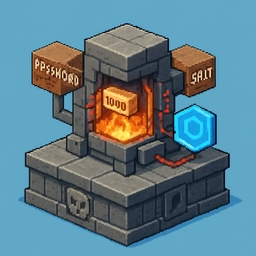







Derive Secure Cryptographic Keys from Passwords
Password-based key derivation is fundamental to security: 转换ing a human-readable password into a cryptographic key that's resistant to brute-force attacks. PBKDF2 (Password-Based Key Derivation Function 2) is the standard method, using salting and iterations to make key derivation computationally expensive, thwarting offline attacks.
This PBKDF2 Generator lets you test key derivation locally in your 浏览器. Configure parameters, derive keys, and verify your cryptographic setup works as expected. Perfect for security testing, understanding PBKDF2 behavior, and validating password handling configurations.
Configurable PBKDF2 Parameters
Password: The input password you're deriving a key from. This is what a user would enter; PBKDF2 stretches it into a full cryptographic key.
Salt: Random data added to the password before hashing. Prevents rainbow table attacks and ensures different users with the same password get different keys. The tool 生成s random salts or lets you specify your own for reproducibility.
Iterations: How many times the hashing function is applied. More iterations = harder to brute-force but slower to compute. OWASP recommends 600,000 iterations (2024), though 100,000 is commonly used. Adjust based on your security vs. performance needs.
Hash Algorithm: Choose from:
- SHA-1: Legacy, weaker, but still widely supported
- SHA-256: Standard choice, good balance of security and speed
- SHA-384: Stronger than SHA-256, slightly slower
- SHA-512: Maximum security, for highest requirements
Key Length: Output size (128 bits, 256 bits, or 512 bits). Use 256-bit keys for modern cryptography.
Output 格式化s
生成d keys display in:
- Hex: Standard hexadecimal encoding, easy to copy and paste
- Base64: URL-safe encoding, useful for embedding in URLs or config files
Common Security Development Scenarios
Testing Key Derivation: Before implementing PBKDF2 in your application, test parameters here. Verify that different iterations produce different keys, understand how salt affects output, and confirm your chosen algorithm works as expected.
加密ion System Testing: When building 加密ion systems that use PBKDF2 to derive keys from passwords, test the derivation process locally first.
Security Configuration Verification: Confirm your application's PBKDF2 implementation produces the same keys as this tool. If they match, your implementation is correct.
Educational Understanding: Learning how password hashing works? Experiment with iteration counts, salts, and algorithms to understand their impact.
Compliance Testing: Verify your implementation meets current standards (OWASP 2024 recommends 600,000 iterations for password hashing).
Why Iterations Matter
Iterations control security:
- Too few iterations (< 100,000): Vulnerable to brute-force attacks
- Recommended (600,000+): Slows attackers significantly, recommended by OWASP
- Higher iterations: Maximizes security but slows key derivation (noticeable user delay)
For user login systems, 100,000-600,000 is typical. For high-security applications, use higher values even if it adds a few seconds to key derivation.
Salt Generation
The tool can 生成 a random 16-byte salt with one click. Use this for testing, or specify your own salt for reproducibility (useful for testing that the same password and salt always produce the same key).
Completely Secure, 100% Local
All PBKDF2 computation happens in your 浏览器 using the native Web Crypto API. Passwords, salts, and derived keys never leave your machine, making this safe for testing with real credentials and sensitive cryptographic operations.
Copy & Use
生成d keys copy to your 剪贴板 with one click. Paste directly into test code, configuration files, or cryptographic tools for further testing.