 Tiny Online Tools

Why your cut part is always a bit too small
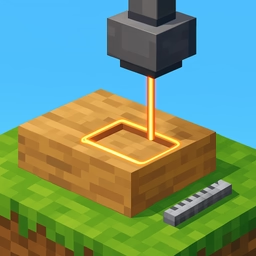
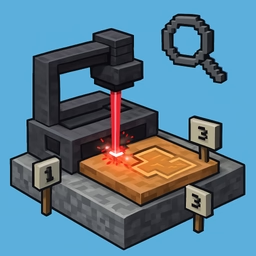
A laser, plasma torch, or blade does not remove a line — it removes a strip of material centred on the toolpath, as wide as the kerf. Cut a 100 mm square along its drawn edges with a 0.2 mm kerf and the finished square measures roughly 99.8 mm: the beam ate half the kerf off every edge. Kerf compensation offsets the toolpath so the finished part, after material is removed, lands exactly on the size you drew.
Outward for edges, inward for holes
The direction matters and it is opposite for the two cases:
- An outer contour — the boundary of the piece you're keeping — is offset outward by half the kerf, so the beam's inward half brings the cut edge back to your line.
- An inner contour — a hole cut into the piece — is offset inward by half the kerf, so the beam's outward half brings the hole's edge out to your line.
For shapes nested several levels deep (an island inside a hole inside the outer piece, and so on), the direction has to alternate with each level of nesting. This tool works that out automatically: it finds each contour's immediate container (the smallest shape that encloses it) the same way the Laser Cutter File Inspector does, and sets the default direction from nesting depth. You can flip any individual contour by hand if your case does not follow the usual pattern.
Real polygon offsetting
Offsets are computed with clipper-lib, the integer-geometry polygon library this site's 3D slicing tools already use for the same job — not an approximation that can self-intersect on tight corners.
What it needs
A kerf width in millimetres (check your machine or run a quick test cut — kerf varies by material, thickness, power and speed) and an SVG with closed contours. Open contours cannot be offset as a closed shape and are skipped, with a count shown so you know to fix them first (the Laser Cutter File Inspector will find exactly which ones).
Privacy
The SVG is parsed, offset and exported entirely in your browser. Nothing is uploaded.