 Tiny Online Tools
Build the whole LOD ladder in one pass
Level of detail is the oldest real-time rendering trick there is: draw the detailed mesh when the object is close, swap to a lighter one as it recedes, and spend the saved triangles somewhere the player is actually looking. Getting it right by hand means decimating the same model four times at four budgets and then guessing the switch distances. This free online LOD generator does the whole ladder at once, in your browser.
How the chain is built
You pick how many levels you want (2 to 5) and how much each level reduces. At 50%, a four-level chain gives you 100% / 50% / 25% / 12.5% of the original triangle count.
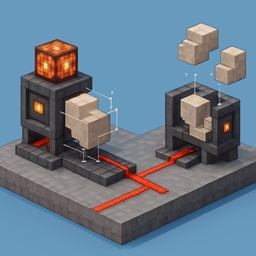
One detail matters more than it sounds: each level is decimated from a fresh copy of the original, never from the level above it. Chaining decimation compounds quadric error — LOD3 built from LOD2 built from LOD1 accumulates three rounds of approximation and looks noticeably worse than LOD3 built directly from the source at the same triangle budget. That is why this tool re-simplifies from scratch every time.
Switch distances
A LOD chain without switch distances is half a job. The tool estimates them from the model's bounding sphere and a screen-space error budget you set: how much of the screen the geometric error is allowed to occupy before the next level down becomes acceptable.
Treat these as a starting point, not gospel. Real switch distances depend on your camera's field of view, your target resolution and how forgiving your art direction is. But starting from a number derived from the model's actual size beats starting from zero.
Two export modes
Separate files gives you model_LOD0.glb, model_LOD1.glb and so on in a ZIP, alongside a lods.json manifest with triangle counts, byte sizes and switch distances. Use this when your engine streams levels independently.
Single GLB packs every level into one file as sibling nodes named LOD0 through LODn — the layout Three.js's LOD helper and several engines look for. Use this when you want one asset to drop into a scene.
Either way, the tool prints a copy-pasteable Three.js snippet wiring the whole chain up.
Typical budgets
- LOD0 — the hero mesh, whatever your source is
- LOD1 — around 50%, for mid-distance
- LOD2 — around 25%, where silhouette still matters but detail does not
- LOD3 — around 10%, for distant background instances
Below about 2% of the original, silhouettes usually collapse. Flip through the preview levels before committing.
Privacy
Decimation runs locally in WebAssembly. Your game assets, scans and client models are never uploaded.