 Tiny Online Tools





Make SQL Readable with Dialect-Aware Formatting
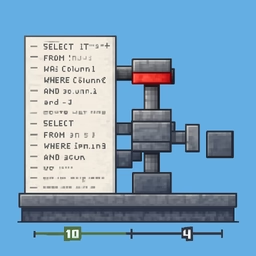
SQL queries from ORMs, query builders, or generated code are often crammed into single lines or formatted inconsistently. Trying to review SELECT * FROM users WHERE id = 1 AND status = 'active' AND created_at > '2024-01-01' ORDER BY name is painful. Properly formatted SQL with appropriate line breaks and indentation is drastically easier to read and debug:
SELECT *
FROM users
WHERE
  id = 1
  AND status = 'active'
  AND created_at > '2024-01-01'
ORDER BY name
This SQL Formatter handles the transformation automatically, respecting your specific SQL dialect and style preferences.
Multi-Dialect Support
SQL syntax varies by database. This formatter supports:
- Standard SQL: Generic, works with most databases
- PostgreSQL: With PostgreSQL-specific syntax
- MySQL & MariaDB: MySQL/MariaDB variants
- SQLite: SQLite dialect
- T-SQL: Microsoft SQL Server
- BigQuery: Google BigQuery SQL
- Hive & Spark: Data warehouse engines
- TiDB: Distributed SQL database
Select your database, and the formatter respects dialect-specific keywords and syntax.
Customizable Style Options
Keyword Case: Choose how SQL keywords are formatted:
- UPPERCASE:
SELECT * FROM - lowercase:
select * from - Preserve: Keep keywords as-is in the input
Indentation Size: 2 spaces (compact) or 4 spaces (readable), matching your team's SQL style guide.
Comma Position: Decide where commas appear in SELECT lists and WHERE clauses:
- Before: Place commas at the start of each new line
- After: Place commas at the end of each line (traditional)
Common SQL Development Workflows
Code Review: Before reviewing generated or ORM-produced SQL, format it for readability. It's much easier to spot errors or optimization opportunities in formatted output.
Query Debugging: When a complex query isn't returning expected results, format it to understand the structure, identify logical issues, and verify WHERE clauses and joins.
Documentation & Examples: Format SQL queries before including them in documentation, README files, or tutorials. Well-formatted examples are easier for others to understand and modify.
Style Consistency: Enforce consistent SQL formatting across your team by using this tool as a formatter before committing queries to version control.
Performance Analysis: When investigating slow queries, format them first. Well-structured SQL is easier to analyze for missing indexes, unnecessary joins, or inefficient subqueries.
SQL Migration & Refactoring: When moving queries between systems or refactoring large SQL files, format them to ensure consistency and catch issues during transition.
One-Click Copy or Download
Formatted SQL copies to your clipboard with one click or downloads as a .sql file. Use it directly in your codebase, database client, or documentation.
Respects String Literals
The formatter is intelligent about string content—it won't break or reformat text inside quoted strings, ensuring your SQL data remains intact and correct.
100% Browser-Based Formatting
Formatting happens entirely in your browser using the proven sql-formatter library. Your queries never leave your machine, so you can safely format queries containing sensitive data or proprietary business logic.