 Tiny Online Tools




Advanced Dice Mechanics: Beyond Simple Rolls
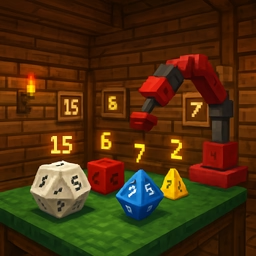
While basic dice rolling determines many game outcomes, sophisticated tabletop RPG systems use complex notation to describe intricate probability mechanics. Keeping the highest rolls, rerolling failures, and allowing dice to "explode" (rolling again when hitting maximum) create nuanced probability distributions. The Advanced Dice Roller understands this full notation, handling everything from simple 2d6 to complex XdY+Z expressions with modifiers.
Dice Notation Language
Tabletop RPG communities developed a standardized notation for expressing dice rolls:
Basic Format (XdY+Z): Roll X dice with Y faces, add Z. Example: 4d6+2 means roll four six-sided dice and add 2 to the result.
Keep Highest (kh): Some systems allow rolling extra dice but only counting the highest. Example: 4d6kh3 means roll four d6 and keep only the highest three. Character creation in Dungeons & Dragons uses this rule—roll extra dice to find the best results, discarding poor rolls.
Keep Lowest (kl): Less common but used in certain systems. Keep only the lowest N dice for penalties or specific mechanics.
Reroll Below Threshold (r<): Failed rolls can be rerolled under certain conditions. Example: 2d6r<2 means roll 2d6, and if either die shows a 1, reroll it. This prevents terrible outcomes while maintaining suspense.
Exploding Dice (!): When a die shows its maximum value, roll it again and add the new result. Example: 2d6! means roll 2d6, and if either die shows 6, roll it again. Explosions can chain—a newly-rolled 6 explodes again. This mechanic creates the possibility of extraordinarily high rolls, adding drama to critical moments.
When Advanced Mechanics Matter
Character Creation: Different RPG systems use different rolling methods. Pathfinder uses 4d6kh3 (roll four d6, keep the highest three) to generate ability scores. Understanding this notation ensures characters are built correctly.
Combat Resolution: Complex damage rolls like "3d6 reroll 1s" are faster and more accurate with a tool that understands the notation.
Spell Effects: Magic systems sometimes involve explosions or cascading effects. Rolling 2d6! to see if magical effects cascade requires understanding how explosions work.
Homebrew Rules: Game masters create custom rules and need tools flexible enough to express them. The Advanced Dice Roller's notation is extensible enough for most homebrew mechanics.
Batch Rolling and Statistics
When building balanced encounters, you need to understand probability distributions. Rolling the same expression 50 times shows average outcomes, minimum rolls, and maximum rolls. Designers use this statistical feedback to balance difficulty against player character power.