 Tiny Online Tools
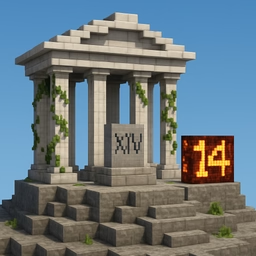







Bridging Ancient Numerals and Modern Mathematics
Roman numerals still appear everywhere—from clock faces and copyright dates to historical documents and academic outline formatting. Yet most people struggle to decode MCMXCIV or convert 1994 into its Roman equivalent. The Roman Numeral Converter instantly bridges this gap, translating seamlessly between our modern decimal system and the elegant notation of Ancient Rome.
The Legacy of Roman Numerals
Roman numerals represent one of humanity's oldest numerical systems. I, V, X, L, C, D, and M—seven symbols that combine through position and subtraction rules to represent any number. While the system served Rome admirably, its lack of a zero and positional notation made it eventually obsolete for mathematics and commerce. Yet it persists symbolically across our modern world.
Where You Encounter Roman Numerals Today
Copyright and Publication: Every film and television production displays a copyright year in Roman numerals during opening credits. That string of letters appearing for a fraction of a second? It's often the current year in Roman notation.
Clock Faces: Elegant analog clocks traditionally display hours in Roman numerals. Reading an ornate clock requires understanding that XI means eleven and that IV means four (not six, due to the subtractive principle).
Formal Outlines: Academic writing and legal documents structure outlines as I, II, III, then A, B, C, then 1, 2, 3. Understanding Roman numerals is essential for navigating complex hierarchical documents.
Historical Records: Reading about events "in the year MCCCL" requires quick conversion. Genealogy research and historical document analysis frequently involve Roman numeral interpretation.
The Conversion Process Simplified
Manually converting between systems demands memorizing positional rules and subtraction principles. The tool eliminates this cognitive burden—type 1984 and instantly see MCMLXXXIV, or enter XCIV and immediately know it's 94. Perfect for students, historians, clock readers, and anyone encountering these timeless numerals.